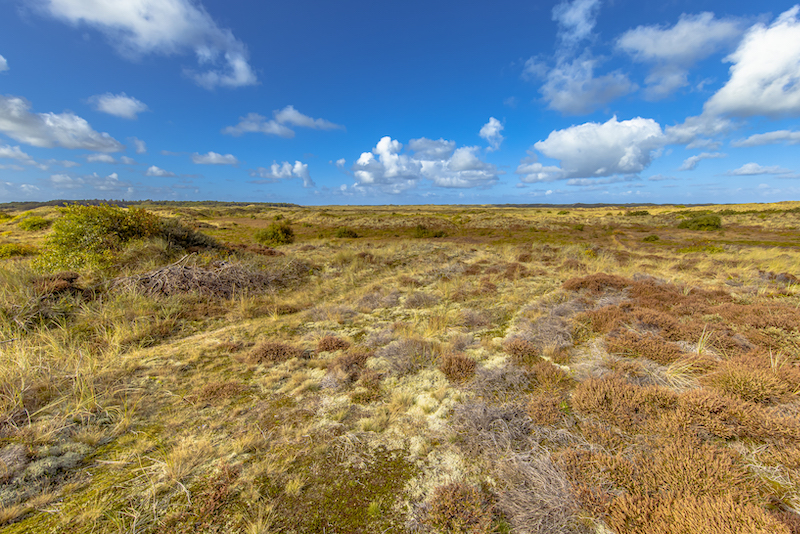
The Welsh word rhos has two meanings, both nature-related. The first is a heath or a moor. The second is that it’s an old-fashioned plural form of rhosyn, which is the Welsh for the blodyn (flower) that’s called a rose in English.
As you might expect for a word with two meanings, it also has two plurals. In the first sense, the plural is rhosydd (moors). In the second sense things are a bit more complicated – because in Welsh, for most plant names the simpler form of the word represents the plural. So rhos itself traditionally means roses as a collective, or even the concept of roses, with rhosyn being the singular.
rhos
moor / roses
rhosydd
moors
But these boundaries aren’t strictly adhered to in modern spoken Welsh, and some people do say rhos instead of rhosyn to refer to just one of the blodyn. And it’s also certainly not the only possible plural – you’ll hear rhosod, rhosynnau, or the more casual rhosys being used to refer to multiple individual roses.
The two meanings also have separate etymologies. Whilst rhos as in a moor is a native Celtic offering, cousin of almost-identical words with similar meanings in Cornish, Irish, and Scots Gaelic, rhos as in a rose or roses is a loan word from the Latin rosa. The singular, rhosyn, actually derived from rhos rather than the other way around, which makes sense given it’s one of those Welsh nouns where the plural (called a ‘collective’ in this case) is the default.
This borrowing of rosa also provides the name of some other kinds of planhigion (plants):
- rhosmair / rhosmari = rosemary
- rhosod y cŵn = dogroses
- rhosgampau = rosecampion
- rhoslwyn = eglantine
- rhosod gwyllt = wild roses / briar roses
Rhos is not pronounced like the English rose, despite the fact that its second meaning shares the same root. The vowel sound is shorter, and remember also that the rh sound in Welsh is different to the normal r. It’s not just an exaggerated roll but a breathy sound, literally as if you were saying a regular Welsh r and an h at the same time!
It does become r, however, in its only possible mutation – the soft mutation.
Soft mutation
ros
Nasal mutation
N/A
Aspirate mutation
N/A
And if only to make things more confusing, the two senses of rhos are not the same in terms of noun gender. Rhos (moor) is a feminine noun, but rhosyn, the singulative of the collective / plural rhos, is actually masculine.
Now, not everyone in Wales uses the word rhos for both of these definitions. Some don’t use it at all, as there are alternatives in both cases!
As discussed, you could avoid ever needing to use the word rhos to mean rose by referring to a rose as rhosyn and roses as rhosod, rhosynnau or rhosys.
Dw i isio rhosys ar gyfer ein penblwydd priodas.
I want roses for our wedding anniversary.

For a heath or a moor, you could either add a suffix to rhos to create rhosfa or rhostir – now it sounds like moorland – or instead choose a word derived from grug (heather).
Your choices here are grugos or grugle. In the first case, we’re using the suffix –os which has a couple of different uses in Welsh. One of these is to describe the area where a certain planhigyn (plant) is, so grugos is an area where heather is. The second case is similar because it’s using a soft mutated form of lle (a place), so that grugle literally means heather-place.
Crwydrodd hi ar y rhos, gan deimlo’n unig.
She wandered on the moor, feeling lonely.
Did you know that as much of 15% of the world’s rhostir (moorland) is in y Deyrnas Unedig (the United Kingdom)?
In Cymru, it covers large areas of the Southern mountain ranges y Mynyddoedd Duon (the Black Mountains) and y Bannau (the Brecon Beacons), and also some Northern regions like Migneint in Gwynedd and Mynydd Hiraethog. So it’s part of our national heritage – and also key to our bioamrywiaeth (biodiversity). For example, Mynydd Hiraethog is one of the last remaining cynefinoedd (habitats) of the endangered gwiwer goch (red squirrel).
It’s these tirweddau (landscapes) that gave the medieval Welsh teyrnas (kingdom) of Rhos its name, a very small ardal (area) which was later incorporated into the Kingdom of Gwynedd and which is now a region in the Conwy area. Its legacy survives in the names of places like the seaside town of Llandrillo-yn-Rhos.
And on the other end of the country, not far from Abertawe (Swansea), is Rhossili Bay, which consistently ranks as one of the UK’s best traethau (beaches). The name does derive from the rhostiroedd (moorlands), but it’s also known for its morfeydd (salt marshes), twyni (sand dunes), and dramatic clogwyni (cliffs).
So rhosydd, though threatened today, are part of the fabric of Welsh tirwedd (landscape) and hanes (history). We’ve all heard of Heathcliff and Cathy wandering the rhostiroedd (moorlands) of Yorkshire, but let’s show some love to Wales’ rhos, too!