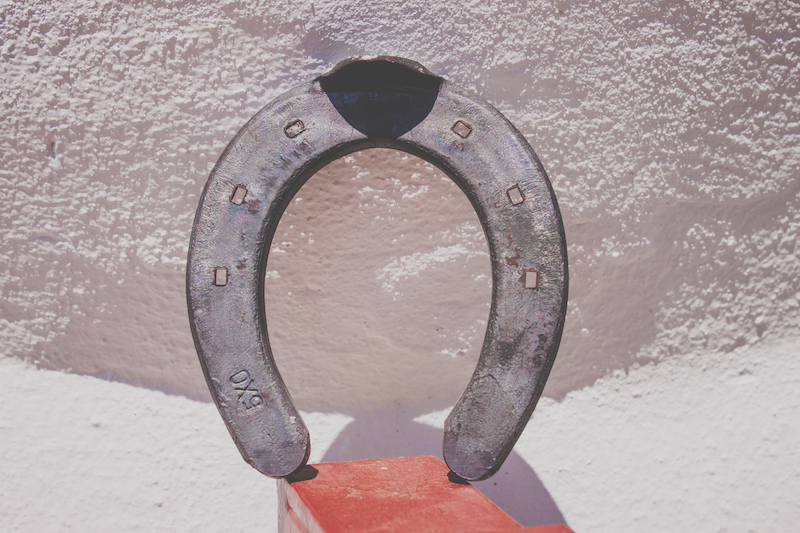
Pedol is a Welsh noun meaning horseshoe. The plural is pedolau.
pedol
horseshoe
Given the ubiquity today of ceir (cars) over ceffylau (horses), you may not think memorising this simple feminine noun is that necessary for modern life. You’d be mistaken – it also has an interesting usage in the description of Welsh phonology, which marks out one of the key differences between Northern and Southern Welsh.
This word is what is called a ‘learned borrowing’, meaning it came into the language as a loan from another language, but not one that was casually adopted by the everyday speaker. Instead, it was a purposeful acquisition by Welsh scholars in the 14th century aiming to fill a semantic gap.
And since then it has had its own etymological children – pedoli (to shoe a horse) and pedolwr (one who makes horseshoes, one who shoes horses).
The word pedalis was at first a Latin adjective meaning that something was related to feet, or was one foot long. Hence pedol’s similarity to the word pedal (pedal), which is the same in both English and Welsh, although North-West Walians may say padlen or padlan instead.
Don’t get it twisted though – pedal is pedal, but pedol is strictly a horseshoe. False friend alert!
Given that it starts with the letter p, this word is subject to all three Welsh mutations, making your job as a learner that little bit harder:
Soft mutation
bedol
Nasal mutation
mhedol
Aspirate mutation
phedol
Some kind of pedolau have likely been used since ceffylau first began to be used by humans for gwaith (work) – they are necessary to protect the carn (hoof) from damage, especially the sensitive cwpan carn (frog / hollow of the hoof). But haneswyr (historians) disagree over when their modern form, made of haearn (iron) rather than lledr (leather), was developed. One possibility is that they were a dyfais (invention) of the Rhufeinwyr (Romans).
Today they are widely considered to represent lwc (luck). In Wales and the rest of Celtic Britain they were considered particularly important because they protected against the tylwyth teg (fair folk). This is because of their being made of haearn, which the tylwyth teg cannot abide.
So pedolau have quite the importance metaphorically, but thinking practically, keeping ceffylau requires not just pedolau but a wide range of equipment:
- ffrwyn = bridle
- tennyn = lead
- cengl = girth
- blanced = blanket
- cyfrwy = saddle
- pilyn pwn = saddle pad
- esgidiau = boots
l’m not very knowledgeable about the marchogol (equestrian) world, so let me know what I missed!
Dyn ni’n meddwl bod angen pedolau newydd ar ei cheffyl.
We think her horse needs new shoes.
But the reason I wanted to write about the word pedol today has nothing to do with ceffylau. I’m keen to talk about u bedol, the name used in South Wales for the letter u in the Welsh alphabet.
First off, as you can see, u bedol uses the soft-mutated form of the word. This suggests that, when it operates as a noun, the letter u is considered feminine – that would cause adjectives, and nouns functioning as adjectives, to soft mutate when used to describe it.
The reason u bedol needs a separate name is that in South Wales, this letter breaks the rule that in Welsh, all letters have one sound and all sounds have one letter. While North Walians pronounce u like this:
And i like this:
In South Wales, both letters are pronounced as above, like the North Walian i – which is pretty much identical to the vowel found in English words like bean and key. So they are differentiated with nicknames. I becomes i dot, and u is u bedol or u gwpan.
Some people render i dot as i ddot, but in my experience this is less common.
I’m from mid-Wales and although the Welsh speakers I knew growing up had a variety of accents and dialects, I do remember using the terms i dot and u bedol in the primary school classroom for clarity and ease. In South Wales, this (or the alternative u gwpan) would be ubiquitous – and to be honest these terms probably would be recognised by most people in North Wales, but they’re just not necessary because the sound of the letters is distinct anyway.
Mae’r gair hwn wedi’i sillafu gydag u bedol, nid i dot.
This word is spelt with a ‘u’, not an ‘i’.
The letter u isn’t the only thing described in Welsh as being shaped like a pedol. We have the multi-purpose adjectives pedolffurf and pedolog (u-shaped), and many things that in English are prefixed U and described with the word pedol in Welsh. For example a tro pedol (U-turn) and a peipen bedol (U-bend, in piping).
But things that are described with a U for a reason other than their shape wouldn’t receive this treatment. For example, a U-boat, as in a submarine, is a llong danfor, and a U film, as in one rated suitable for children and families, is just a ffilm U.