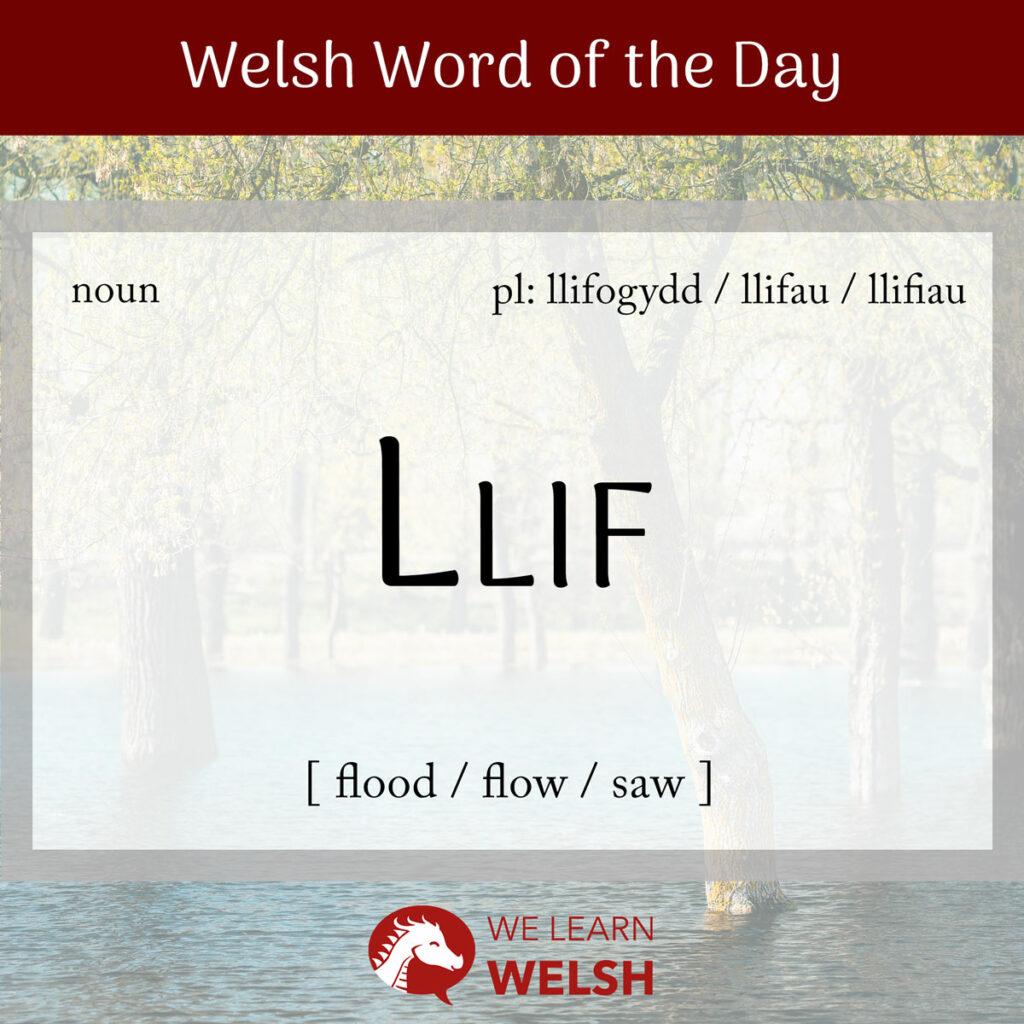
Today’s word of the day is llif, a word with many different meanings including flow, flood and even saw!
llif
flood, flow, current, saw
Llif is only susceptible to the soft mutation.
Soft mutation
lif
Nasal mutation
N/A
Aspirate mutation
N/A
The gender of llif varies according to its meaning. When llif means flow, current or flood, it is feminine. However, when llif means saw (as in the tool), it is masculine. Although you can nearly always tell which meaning is being used by looking at the surrounding context, the gender of llif gives you an extra clue. For instance, llif mawr means a big saw, but llif fawr means a big flood. You can work this out by remembering that singular feminine nouns cause adjectives to undergo the soft mutation.
The different uses of llif are much easier to tell apart in their plural forms:
- llifau = flows, currents
- llifiau = saws
- llifogydd = floods
But be careful when turning llif into a verb: llifo means to flow but llifio means to saw. One letter makes a big difference!
Mae’r afon yn llifo’n gyflym.
Mae’r adeiladwr yn llifio’n gyflym.
The river is flowing quickly.
The builder is sawing quickly.
To translate the English to flood, gorlifo (to overflow) is probably the most appropriate verb.
When llif means flow it is often used to construct cyfansoddeiriau (compound words), where it appears in its mutated form. For instance, the Welsh word for period is mislif (lit. month flow), and the word for haemorrhage is gwaedlif (lit. blood flow). The Welsh term for a stream of consciousness or train of thought is llif yr ymwybod / llif y meddwl. This concept forms the foundation for a type of writing often studied in Welsh literature classes and performed at Eisteddfodau: the ymson or soliloquy/monologue.
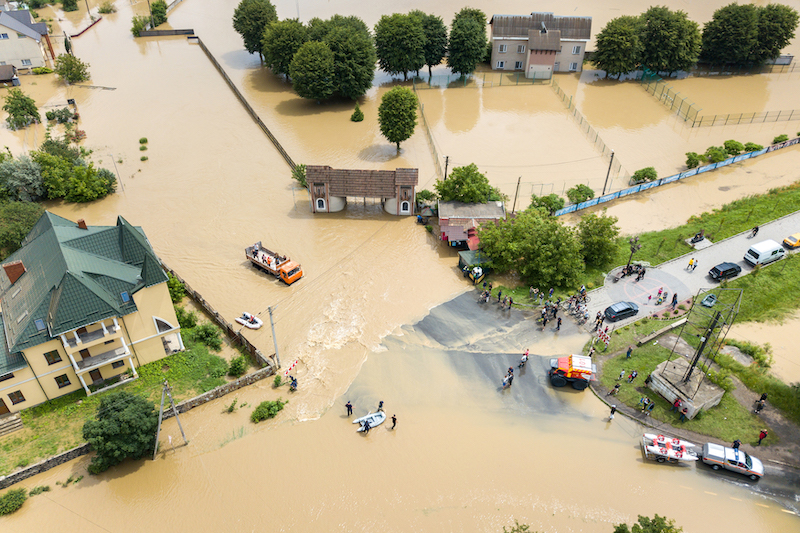
Growing up in mid Wales, I saw a lot of llifogydd, due to living in a cwm (valley) next to yr Afon Gwy (the River Wye). In hydref (autumn) and gaeaf (winter), it would bwrw hen wragedd a ffyn (rain cats and dogs lit. rain old women and walking sticks) more often than not, and the river would burst its banks, cutting us off from the outside world. Watching roads turn into rivers really impressed on me the power of natur (nature), and how important it is to parchu (respect) the natural world in all its beauty and danger.
Bydda’n ofalus gyda’r llif ‘na – mae e’n finiog!
Be careful with that saw – it’s sharp!
Unfortunately, due to newid hinsawdd (climate change), winter rainfall across Wales is predicted to increase by 11% by the 2040s, with the South-West being hit the most heavily (according to the 2009 Welsh government report Climate Change: its impacts for Wales). Floods are predicted to become amlach (more frequent) and gwaeth (worse), and I worry about what this means for my hometown.
The future is also likely to bring more llifogydd arfordirol (coastal floods) due to codi lefel y môr (sea level rise). For instance, according to Climate Central’s interactive map, parts of Caerdydd (Cardiff), Casnewydd (Newport) and Llanelli (as well as sections of the M4 motorway!) are at risk unless further action is taken to reduce allyriadau carbon (carbon emissions).
Speaking of the coast, llif is also sometimes used as a word for the sea, referring to the flow of the llanw (tide). In this context the f at the end is usually dropped, so if you hear someone refer to y lli, they probably mean the sea. As a child, I read a book called Ci Ger y Lli (Dog by the Sea)!
Lli even appears in my name: Gwenllian, a variation of Gwenlli. This name means white flow, likely referring to the white foam that appears on the tips of ocean waves. You can also say Mae’r afon yn ei lli – the river is flowing (lit. the river is in its flow). This phrase is used in a lovely Welsh song by Cerys Matthews called Carolina – give it a listen and see if you can make it out!