Talking about teulu (family) is often one of the first things you want to do in a new language. Once you’ve learnt the terms for your closest perthnasau (relations) – mam (mother), tad (dad), chwaer (sister), and brawd (brother) being particularly important – one word that’s likely to be near the top of your list is cousin, the child of your ewythr (uncle) or modryb (aunt).
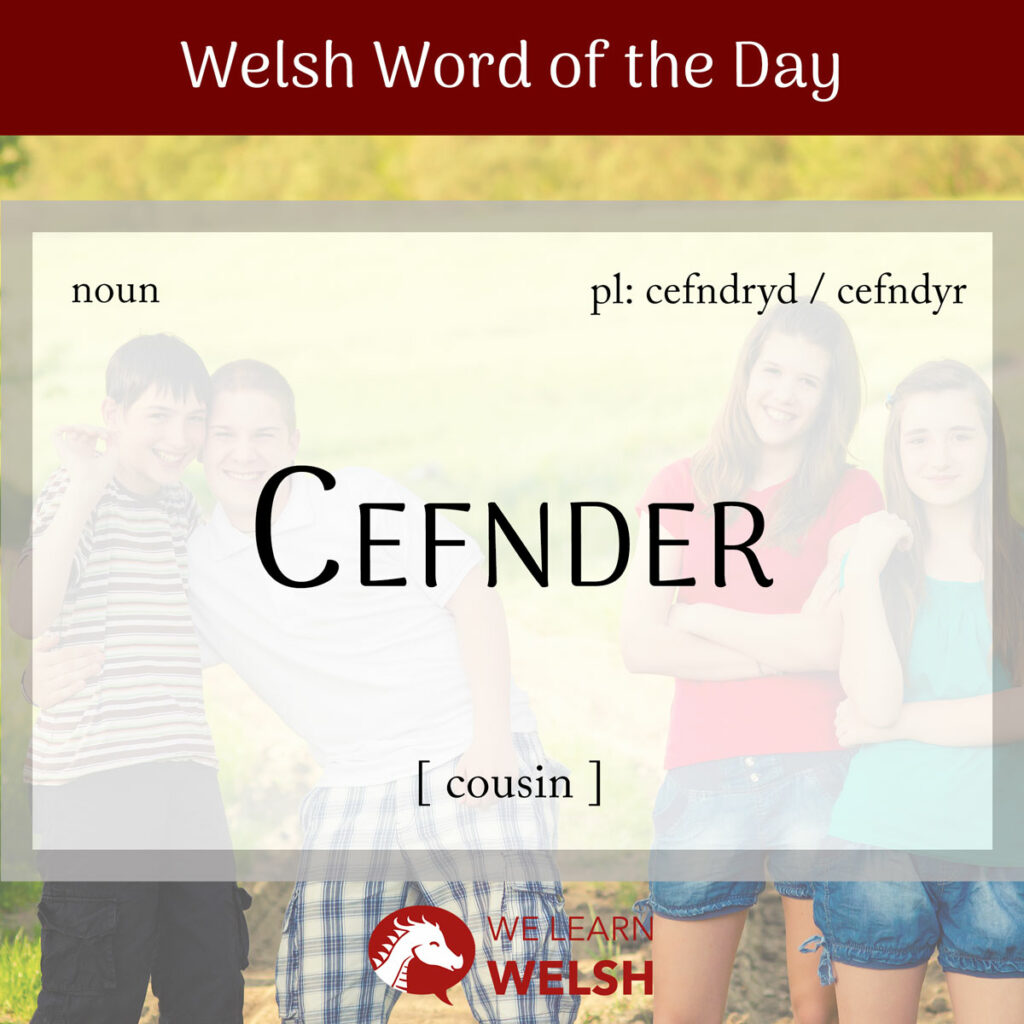
Cousin is a bit of a tricky one in Welsh though because there’s not just one relation – it depends on the gender. Our word of the day today, cefnder, is the masculine form, which is normally treated as the default. However, for a female cousin you need a completely different word: cyfnither.
As you might expect, cefnder is treated as a masculine noun and cyfnither as feminine. There are numerous different plurals floating around in use for both words, but the most common are cefndryd or cefndyr for cefnder and cyfnitheroedd for cyfnither.
cefnder
cousin (male)
cefndyr
cousins (male)
cyfnither
cousin (female)
cyfnitheroedd
cousins (female)
What both words have in common etymologically is the last syllable, which comes from the word derw. In modern Welsh derw means oak trees, but in these words it’s operating as an element meaning true or sure. This creates the literal meaning true kinsman, from the archaic word caifn for kinsman or distant cousin, and in the case of cyfnither, true niece, as niece in Welsh is nith. The additional prefix cyf means together or equal.
Specifically, cefnder and cyfnither refer to first cousins – sometimes in formal texts the adjective cyfan (whole) is added to make that even clearer. Welsh actually has a term for a second cousin, too, which is cyfyrder. There are even words for yet more distant relations, but they are not that commonly used by most modern speakers.
Speaking about cousins once removed is a little bit more unwieldy. Generally, you would describe the exact relationship, be it plentyn fy nghefnder / nghefnither (my cousin’s child), cefnder / cefnither fy mam (my mum’s cousin), or cefnder / cefnither fy nhad (my dad’s cousin). Or, as in English, you can drop the specificity and simply call them your cefnder / cefnither.
Here is how cefnder mutates:
Soft mutation
gefnder
Nasal mutation
nghefnder
Aspirate mutation
chefnder
Because they begin with the same letter, the same pattern applies to cyfnither too.
But there are some differences in how this operates in practice – for example, the cousin is y cefnder if he is male, but y gyfnither if she is female, because only feminine nouns mutate after y (the).
It’s a good idea to get comfortable with the mutations of these words, because you’re very likely to often use them with personal pronouns such as fy (my). In Welsh, personal pronouns are one of the most common causes of mutation in colloquial speech.
- fy nghefnder / fy nghyfnither = my cousin
- ein cefnder / ein cyfnither = our cousin
- dy gefnder / dy gyfnither = your cousin (informal singular)
- eich cefnder / eich cyfnither = your cousin (formal or plural)
- ei gefnder / ei gyfnither = his cousin
- ei chefnder / ei chyfnither = her cousin
- eu cefnder / eu cyfnither = their cousin
Notice that in these examples, the mutation doesn’t change based on whether it is cefnder or cyfnither. It’s the gender of the person whose cousin it is that decides the mutation, not the cousin themself. This is different to how personal pronouns work in a lot of European languages, so watch out!
Es i i weld y sioe gyda fy nghefnder a’i ffrind.
I went to see the show with my cousin and his friend.
In general, Welsh is a much more gendered iaith (language) than English. Cefnder and cyfnither are far from the only words that are separated based on gender. Take athro (teacher, male) and athrawes (teacher, female). Or, for a teulu-related example, tadcu / taid (grandpa) and mamgu / nain (grandma) – there is no word for grandparent.
The lack of neutral words can cause difficulties when you’re discussing someone whose gender you don’t know, or when you’re speaking in the abstract. Often the solution to this is simply to use the masculine as if it were a neutral form – and actually this is done for many words in the language anyway, like plentyn (child), which is technically a masculine noun but which can certainly be used to describe a merch (girl, daughter, woman, or, as here, female child).
This grammatical puzzle has become yet more pressing in recent years. This is because people who are non-binary – not identifying as a dyn (man) or dynes (woman) but preferring to present themselves and be referred to in a gender-neutral way – have been steadily gaining more and more visibility and acceptance.
Non-binary Welsh speakers often use plural terms such as nhw (they), but many feel that this doesn’t sound natural, since there’s not a history of the term being used to refer to someone whose gender is unknown, as there is in English. And that device doesn’t work at all for words like cefnder and cefnither where the plural forms are gendered too.
Ultimately, Welsh is a highly gendered language, and it wouldn’t be possible or desirable to strip that from it. But coining new, additional terms is one possible path forward, which has been suggested by both linguists and non-binary people themselves.
What we do know about the Welsh language is that it’s resilient – and in a time where numbers of learners are surging, I for one definitely have faith that speakers of Welsh can adapt and innovate to meet everyone’s needs while maintaining the unique character of our beautiful iaith.