
Symbolising simultaneously cariad (love) and dicter (anger), lwc (luck) and perygl (danger), the colour coch (red) contains multitudes. And it’s particularly important to Cymru (Wales) because it’s the lliw (colour) of our iconic emblem, y ddraig goch (the red dragon).
coch
red
As is the case with many lliwiau (colours), coch is a very old word, used as both an ansoddair (adjective) to describe when something is coch, and an enw (noun) to refer to the abstract concept of coch itself. It’s actually a borrowing from the Latin word coccum that originated as a word used to describe red berries, itself coming from the ancient Greek kokkos.
Coch could mutate in any of three ways:
Soft mutation
goch
Nasal mutation
nghoch
Aspirate mutation
choch
Plus, it can change to a plural form, which is cochion. So, for example, blodau cochion would be red flowers. But these days blodau coch is generally considered acceptable too.
Learning about lliwiau is often an interesting experience because they don’t always map clearly from one language to another. Take the classic example of the word glas (blue), which historically referred to all of blue, green, and silver.
Likewise, though coch in Welsh has always meant red, its usage doesn’t stop there. Take the expression arian coch (red money), once common to refer to coppers. And ginger hair is usually called gwallt coch (red hair), just like in English.
Continuing on the ginger theme, coch appears in one of the three most commonly phrases used for gingerbread: those being torth sinsir (ginger loaf), bara poeth (hot bread), and cacen goch (red cake).
The word was also historically used for brown. This lliw in Welsh is now usually just referred to as brown, since the language doesn’t have one single native word that exactly captures the range of meaning encompassed by the English. Still, coch as brown does survive in set phrases, such as bara coch (brown bread) and siwgwr coch (brown sugar). Plus, a ceffyl (horse) that is brown or bay may be called coch in Welsh.
Interestingly coch can be used for non-lliw-related meanings, too. It can be an insult – meaning that something or someone is bad quality or unskilful. Lastly and lewdly, coch sometimes appears in set phrases to describe something vulgar, particularly in a sexual context. Storis coch (red stories) means dirty jokes, or dirty conversation more generally.
Dw i’n credu y byddai’n well ganddi bapur wal coch.
I think she would prefer red wallpaper.

What about synonyms? There’s one important example that springs to mind – rhudd. If you think this word looks familiar, you’re right! Rhudd is descended from the proto-Indo-European root *hrewdh. You will mostly find it in older Welsh texts, because it’s considered a literary word, but it’s also the ancestor of rhuddem (a ruby) and rhuddgoch (a flowery word for crimson or red used in descriptive writing).
Another possible example is cochliw (literally red-coloured). It was common in older Welsh to suffix –liw to the end of lliwiau when they were being used as adjectives, but is less common now.
You can alter it slightly to make cochlyd, which means reddish rather than red.
Then there are some fun words for different kinds of coch, like browngoch (maroon), fflamgoch / purgoch (bright red), sgarlad (scarlet), gwaetgoch (blood red), and dugoch (dark red). Of course light red is just pink, and for this the Welsh perform the classic trick of stealing the English word and usually just say pinc, although lliw rhos (rose colour) is an option.
Pinc actually brings us to our next subject, which is gwrido (blushing). That’s because in literary Welsh, gwritgoch (literally blush red) was sometimes used for pink. It’s an evocative way of describing the lliw, isn’t it?
But talking about gwrido is one of the key ways in which we use the word coch, too. You can describe the action of gwrido as cochi (blushing or reddening), and if it’s a particularly evident gwrid (blush) / cochni (blush / redness) you might say that they are cochi at y clustiau (reddening to the ears), cochi fel tân (reddening like fire), or even mynd yn goch fel twrci (going red like a turkey).
If someone just naturally has a ruddy complexion and they’re not feeling swil (shy) or chwithig (awkward, embarrassed), you’d instead say that they are bochgoch (rosy-cheeked). This word is also one colloquial nickname for the pabi (poppy) – the pabi coch (red poppy), of course, as opposed to the melyn (yellow) variation that’s in fact known as the pabi Cymreig (Welsh poppy).
Lliwiodd Tirion ei gwallt hi’n goch bedwar mis yn ôl.
Tirion dyed her hair red four months ago.
Pabïau cochion (red poppies) are far from the be all and end all of coch in the natural world, though. There’s the barcut coch (red kite), iconic to the skies of mid-Wales, and of course the beloved robin redbreast, usually known in Welsh simply as robin goch (red robin).
Another small aderyn (bird) known for its plu coch (red feathers) is the redstart, which in Welsh is called the tingoch (literally red-bottom; tin is usually considered quite a rude word). The bullfinch is coch y berllan (orchard red) or simply aderyn coch (red bird).
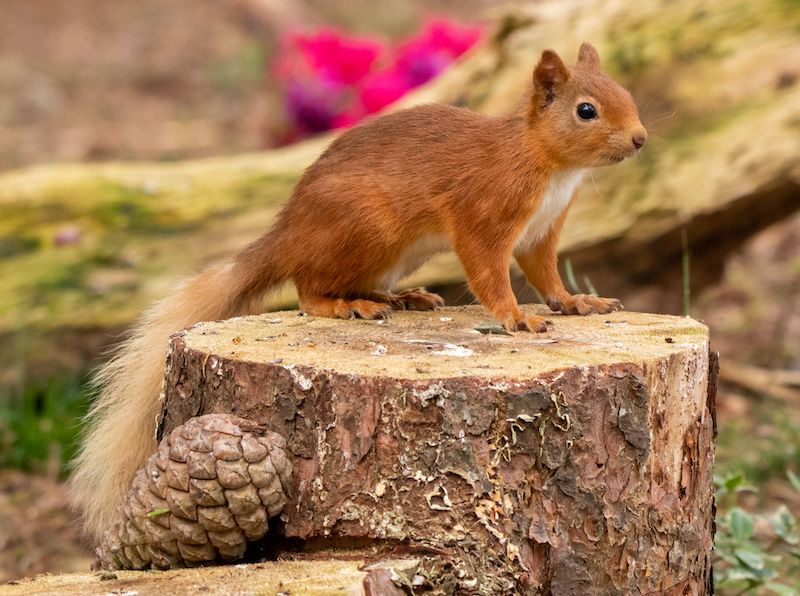
Moving from adar (birds) to anifeiliaid (animals), cochen (red one) is a nickname for the ysgyfarnog (hare) in much of South Wales, and one of the many names for shrew is llygoden goch (red mouse). There are of course plenty more animals that are called coch in both English and Welsh, like carw coch (red deer), or the red squirrel, which in Welsh can be gwiwer goch or is sometimes referred to more specifically as the gwiwer frowngoch (brown-red squirrel).
Of course, gwiwerod coch (red squirrels) are now sadly very prin (rare) in the UK. However, there are significant populations in parts of North Wales such as Coedwig Gwydyr (Gwydir Forest) and Ynys Môn (Anglesey), and attempts are underway to reintroduce them in mid-Wales too.
In the insect world, the cochineal beetle is rightly called the cochbryf (red insect). And one of many people’s favourite Welsh nature terms is buwch goch gota, which literally means tail-less red cow. Obviously, this means ladybird! In South-East Wales, these cute bugs were once also called ieir bach coch cwta (tail-less little red chickens), differentiating them from ieir bach yr haf (butterflies).
In parts of North-West Wales, llysiau coch (red vegetables) and moron cochion (red carrots) are old-fashioned ways of saying moron (carrots), which indeed you might grow in your gardd goch (red garden, sometimes used to mean small vegetable garden, also in the North-West.)
Let’s finish up with a fun fact. Did you know that in South Wales, the phrase llaeth y fuwch goch (milk of the red cow) was once used to euphemistically refer to alcohol?