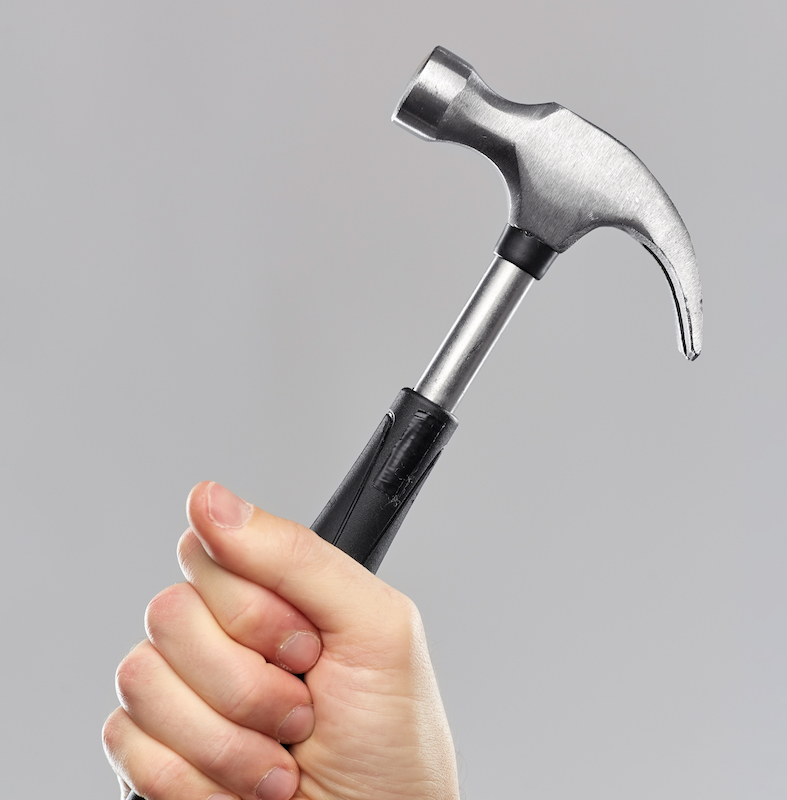
A really useful word to add to your Welsh vocabulary that you might not even have thought to learn is morthwyl (hammer). Linguistically as well as practically, it’s the kind of thing that doesn’t come to mind until you really need it!
Morthwyl is a masculine noun with the plural morthwylion (hammers).
morthwyl
hammer
morthwylion
hammers
The further back you go in the Welsh language, the larger the variety of spellings you’ll find for words you thought were agreed upon. Morthwyl is a great example of this: as recently as the 1800s there are written examples of the vowels being swapped around in all sorts of ways, like mwrthwl, morthyl, and myrthwyl, to name but a few. Indeed, in some parts of North Wales you can still hear mwrthwl and mwthwl as colloquial pronunciations.
It’s likely that the earliest form was morthwl. It’s a loan word from Latin, coming from the word mortulus, which was probably a variation in the British Latin dialect of the standard martellus (hammer).
Since the same loan is evident in the Breton morzhol and the Cornish morthol, the borrowing must have been made in the era of proto-Brittonic, before Welsh, Breton, and Cornish branched off into distinctive languages.
A morthwyl is normally found in a bag offer (toolkit) alongside other equipment like a tyrnsgriw / sgriwdreifar (screwdriver), cyllell (knife), sbaner (spanner), tyndro (wrench), gefel (pliers), tâp mesur (tape measure), and tyllwr (drill).
But a whole host of things beyond the scope of your average bag offer end up being classified as a kind of morthwyl in Welsh. A mallet is just a morthwyl pren (wooden hammer), and the word is also used to refer to the part of a peiriant gwnïo (sewing machine) that holds the nodwydd (needle). A door knocker is often called a morthwyl drws, and in parts of North-West Wales the term morthwyl sinc is even used for a baby’s rattle.
Then there are all the different kinds of morthwylion themselves:
- morthwyl crafanc = claw hammer
- morthwyl pin / morthwyl toi = pin hammer
- morthwyl dau wyneb (crwn) = double-faced hammer
- morthwyl troi pedolau = cat’s head hammer
- agerforthwyl / morthwyl mawr = industrial steam hammer
- bywellforthwyl = axe hammer
- gordd = synonym of morthwyl, particularly for a larger / heavier hammer
To hammer something is morthwylio, although again there are variants like myrthylu, mwrthwlio, and mwthwlo. Often the word will sound different based simply on the speed at which people talk!
But it’s not used as commonly as its English equivalent – to hammer a nail into place could technically be morthwylio hoelen, but most people would instinctively go to curo hoelen (to beat a nail) or gyrru hoelen (to drive a nail) instead.
We also wouldn’t usually use morthwylio metaphorically. For example, if we were talking about knocking hard on something then we’d say curo (to beat), taro (to hit), or dyrnu (to hit with a fist). So the main use of the word is really just to describe working with a hammer in a literal but general sense.
One thing I quite like is that the word for malleable also comes from morthwyl – just as it comes from mallet in English, which as we Welsh speakers know is just a wooden hammer anyway.
So malleable is the tongue-twisting morthwyliadwy, although you can substitute curadwy (beatable) or even just hawdd ei forthwylio (easy to hammer). Taking it one step further, malleability is morthwyledd. For malleability in a more metaphorical sense, it might be better to stick to hydrinedd (docility, governability) or hyblygrwydd (flexibility, pliability).
Mae gen i forthwyl (y) gallet ti fenthyg.
I have a hammer that you could borrow.
Morthwyl appears in a few set phrases in English that you can also use in Welsh. For example, the expression that something is mynd dan y morthwyl (going under the hammer) when it is being sold in an arwerthiant (auction), or the famous image of the morthwyl a chryman (hammer and sickle) that represents comiwnyddiaeth (communism).
Here, chryman is an aspirate mutation of cryman (sickle). The aspirate mutation is the least common kind. It’s often omitted colloquially, but it’s less likely to disappear when it occurs in set phrases like this.
Best of all is the very unique-looking morgi pen morthwyl (hammerhead shark). Did you know that these morgwn (sharks) when hunting literally use their pen (head) as if it were a morthwyl?!