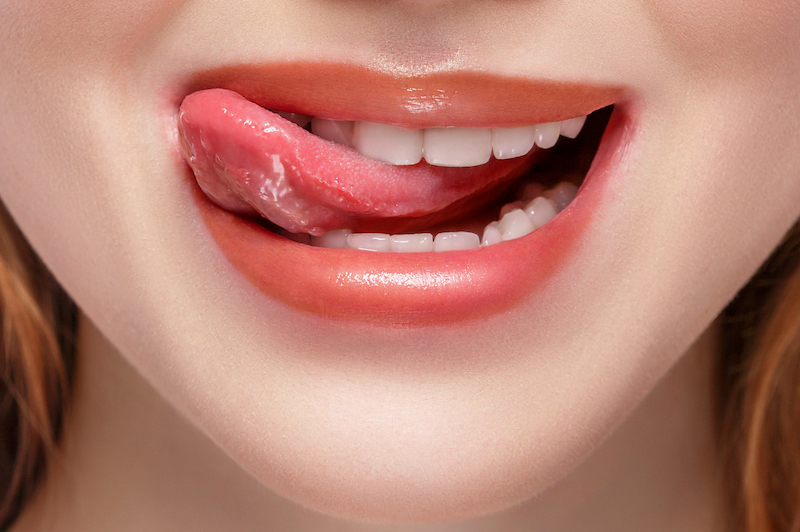
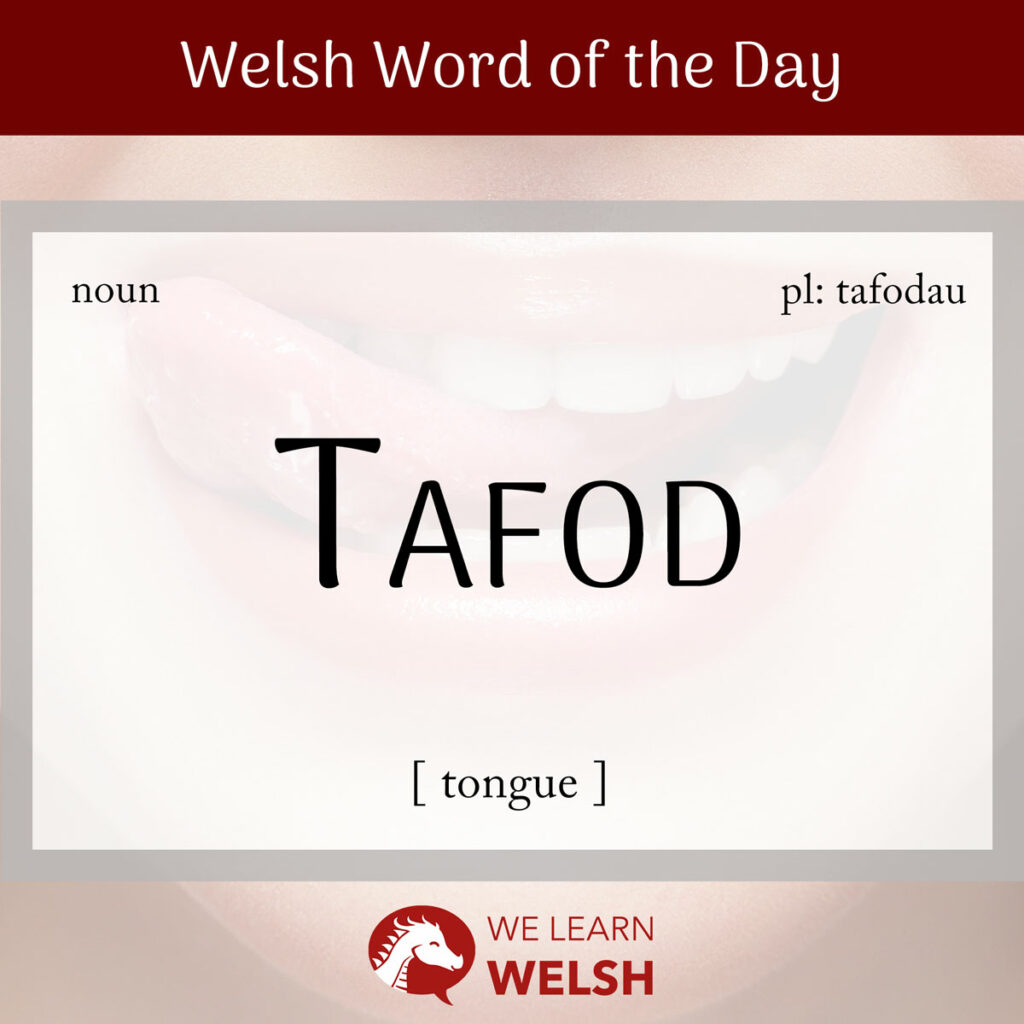
Tongue is one of many, many English words that are spelt in a way that’s completely unintuitive. Luckily, Welsh is a near-totally phonetic language, and its word for tongue is tafod, which is lovely and simple to spell and pronounce.
The plural for tongue is equally simple; it’s just tafodau (tongues).
tafod
tongue
tafodau
tongues
Tafod is a masculine noun. It’s a descendant of the proto-Brythonic *tavod, itself coming from proto-Celtic *tangwass. So the word for tongue is similar in Irish (teanga), Cornish (taves), and Breton (teod). And all these words also share a common ancestor word in proto-Indo-European with words for tongue across Europe and West Asia, such as, indeed, tongue itself.
Here’s how tafod takes mutation:
Soft mutation
dafod
Nasal mutation
nhafod
Aspirate mutation
thafod
The human tafod is a collection of eight cyhyrau (muscles) in the ceg (mouth), that we use to bwyta (eat) and particularly to blasu (taste). It also plays a role in cusanu (kissing)!
While researching this article, I actually found out something that I thought I knew about tafodau and blasbwyntiau (taste buds) isn’t true at all. It’s commonly taught and believed that different rhannau o’r tafod (sections of the tongue) exclusively govern the different blasau (tastes).
But in reality, blasbwyntiau for each of the five basic blasau – hallt (salty), melys (sweet), chwerw (bitter), sur (sour), and sawrus (savoury / umami) – occur all over the tafod. Some gwyddonwyr (scientists) have theorised the existence of two further basic blasau, sbeislyd (spicy) and bras (fatty), for which the same would be true.
In order to do all this very important work, y tafod (the tongue) actually has to be a more complicated organ (organ) than it looks, with multiple different parts.
- blaen y tafod = tip of the tongue
- bôn y tafod = back of the tongue / underside of the tongue
- llinyn y tafod = frenulum of the tongue
- gwraidd y tafod = root of the tongue
- llafn y tafod / rhaglafn y tafod = blade of the tongue
- rhigol y tafod = groove of the tongue
Did you know that the phrase blaen y tafod used to be a bit differently in Welsh than in English? In English it means that we’re trying to meddwl (think) of something and are almost there. This usage has been borrowed into Welsh more recently, but if you mentioned this phrase to a Welsh person 150 years ago they’d have thought it meant someone was ffuantus (hypocritical / insincere).
Mae’r tafod yn organ bwysig iawn.
The tongue is a very important organ.
There’s also the tafodig / tafod bach (uvula), tonsiliau (tonsils), and taflod (roof of the mouth), which aren’t part of the tafod but work closely with it.
Some of the phrases we use to describe the physical actions you can do with your tongue differ a bit in Welsh to in English. Most egregious is sticking your tongue out, which in Welsh is tynnu’ch tafod, literally meaning pulling your tongue. This is a simple swap you can incorporate into your speech to make it sound much more idiomatic!
There are also some tafod-based phrases used in Welsh to describe namau ar leferydd (speech impediments), although I suspect these are falling out of fashion in favour of precise, medical language. But it was once the norm to refer to a nam ar leferydd (speech impediments) as having something ar dafod (on the tongue), with the object in question differing based on both the kind of impediment and the dialect of the speaker. Examples of what could be on the tongue include lusg (a dragging), llyfrithen (a sty), clwm (a knot), blisgyn (a husk), and even deilen (a leaf).
Interestingly, we also say someone is speaking heb ddail ar ei dafod (without leaves on his tongue) when they are being very straight-forward. Another similar construction is heb flewyn ar ei dafod (without a hair on his tongue), sharing the meaning.
Ow! ‘Naeth hynny losgi fy nhafod.
Ow! That burned my tongue.
Across ieithoedd (languages), a huge proportion of the vocabulary we use that has do with tafodau is metaphorical.
We tell people to dal eich tafod (hold one’s tongue) / brathu’ch tafod (bite one’s tongue), even going so far in Welsh as to joke about cadw dy dafod i oeri dy gawl (keeping your tongue to cool your soup, i.e. rather than using it blabber). Another good one is dal dant ar eich tafod (hold teeth on your tongue).
The acclaimed Welsh poet Dic Jones once remarked os dwy glust ac un tafod, dwbwl yr ust a hanner y trafod (since we have two ears and one tongue, let’s double our listening and halve our talking). It makes sense, since hir ei dafod, byr ei wybod (he who has a long tongue is short on knowledge).
When someone does blab or just has a llithriad tafod (slip of the tongue), we call them brac ei dafod (free-tongued). If the cyfrinach (secret) they’ve shared was particularly important, we might even gollwng tafod arno fo (tell him off / verbally abuse him, literally let a tongue fall on him) and give him blas tafod (a scolding, literally a taste of the tongue). We can be more succinct with these expressions and break them right down to the verb tafodi (to berate).
Wrth frwsio’ch dannedd, dylech chi frwsio’ch tafod hefyd.
While your brush your teeth, you should brush your tongue too.
Of course, many people are particularly huawdl (eloquent) and will get praise for siarad (speaking) a lot rather than a pryd o dafod (talking to, literally a meal of tongue). That especially happens when someone’s very good at being perswadiol (persuasive), or perhaps they’ve got a great sense of humour and always speak in a a’i dafod yn ei foch (tongue-in-cheek) manner. You’d say such a person had a tafod arian (silver tongue) or, more simply, a tafod huawdl (eloquent tongue).
On the other end of the social spectrum, there are a whole host of interesting words for people who are tongue-tied, like tafodrwym, tafotglwm, and tafotgaeth. It’s also hard to speak when you are wedi meddwi (drunk); then you might be described as having a tafod tew (fat tongue).
Interestingly, plenty of folk names for wild planhigion (plants) are named after tafodau, too.
- tafod y neidr = adder’s tongue fern
- tafod yr hydd = hart’s tongue fern
- tafod y ci = hound’s tongue fern
- tafod yr ych / tafod y fuwch = borage, literally ox-tongue / cow-tongue
- tafod yr afr = viper bugloss, literally goat-tongue
- tafod yr edn = stitchwort / chickweed, literally bird-tongue
- tafod yr ehedydd = larkspur, literally lark-tongue
- tafod yr oen = goosefoot, literally lamb-tongue
- tafod y gors = butterwort, literally swamp-tongue
- tafod yr ŵydd = sneezewort, literally goose-tongue
There’s yet more! We can also use tafod to describe the tongue of an esgid (shoe), although clust (ear) is more common, or the clapper of a cloch (bell).
Dydy hi byth yn gallu dal ei thafod. Rial hen glecs ydy hi!
She can never hold her tongue. She’s a real gossip!
Last but certainly not least, the tafod is an incredibly important aspect of iaith (language). Not only will you need to master your tafod to be able to pronounce tricky Welsh sounds like ll and get your head around some tricky Welsh cylymau tafod (tongue-twisters), but it’s just part of how we talk about talking.
In English, someone’s tongue means their language. This meaning is not common in Welsh, but we do use tafod to refer to iaith in less direct ways. For example, ar dafod or ar y tafod is one idiomatic way to saying orally or verbally. Similarly, very colloquial or dialectical language is called tafodiaith (tongue-language). And someone who swears a lot, or is rude, is said to have a tafod budr (dirty tongue), or sometimes a tafod fawr (big tongue).
Cymdeithas yr Iaith Gymraeg (The Welsh Language Society), a pressure group which asks the llywodraeth (government) to support and encourage the use of Cymraeg in public life, even named their newsletter after this humble set of cyhyrau. It’s called Tafod y Ddraig (the Dragon’s Tongue).
You can learn more about the Cymdeithas – and practise your Welsh reading skills! – on their gwefan (website). One of their slogans is defnyddia dy dafod (use your tongue). So the Cymdeithas, for one, certainly don’t seem to feel that byr ei dafod, hir ei wybod. After all, how are we supposed to share our gwybod if we don’t use our tafod?