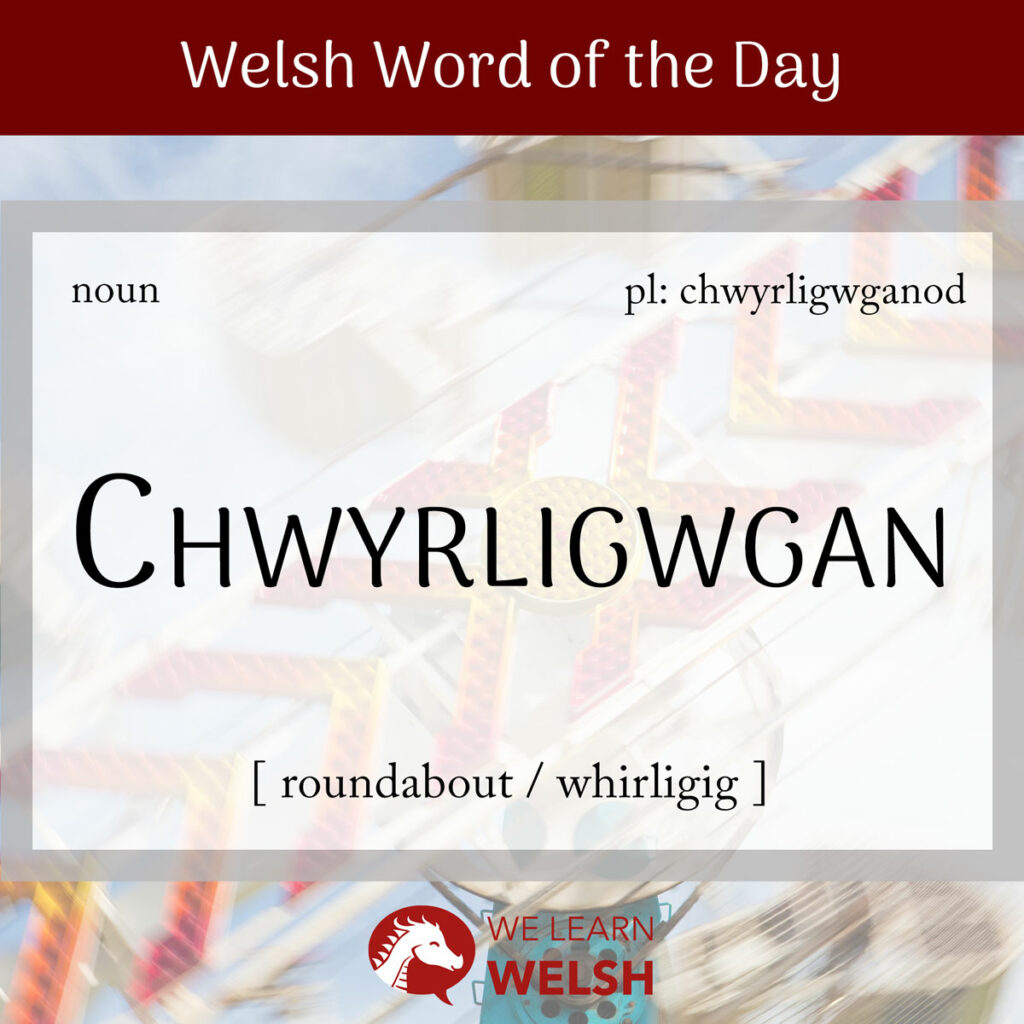
I love asking people what their favourite words in Welsh are, because you always hear such a great variety. But one that comes up time and time again is chwyrligwgan / chwirligwgan, an incredible tour-de-force of a noun that refers to a piece of children’s offer chwarae (play equipment) that troelli (spins). In particular, it’s the word of choice for a roundabout.
As you can see above, chwyrligwgan is usually spelt one of two ways, though if you look back at older texts all sorts of spellings are recorded! Chwrligwgan, chwirli-gwgon, and even whirligwgan have all shown up.
I’ll stick with chwyrligwgan in this article because it’s how I write it, but chwirligwgan has perhaps a slight edge in frequency of use. You should go for whatever you prefer. And however you spell it, it’s easy to pluralise as you just add -od onto the end.
chwyrligwgan
roundabout / whirligig
chwyrligwganod
roundabouts / whirligigs
With its playful vibe and hidden vowels, chwyrligwgan looks so quintessentially Welsh that it’s hard to believe it’s actually an English loan word. But it is – it comes from whirligig, as does the similar Scots borrowing whirligigum / whirlmagig.
And, like most loan words, it’s a masculine noun.
In English whirligig is a bit like thingamybob; it’s a playful way to refer to just about anything, as long as it spins. You might call a top tro (spinning top) a whirligig, for example, or a pinwheel – and in fact there’s no word that I know of in Welsh for a pinwheel other than chwyrligwgan itself.
So this very expansive meaning of whirligig is true for the Welsh chwyrligwgan, too. Geiriadur Prifysgol Cymru (the Welsh University Dictionary) defines it simply as peth sy’n chwyrnellu (something that rapidly turns / whizzes around), specifying only that it is yn enwedig tegan (especially / most often a toy). Similarly Gweiadur (Web-dictionary) calls it a tegan sy’n troelli’n gyflym (a toy that spins around fast).
Combined this gives a pretty good picture, though I do prefer GPC’s version if only for the use of the excellent verb chwyrnellu (to spin around very quickly).
Still, in my experience, most people use chwyrligwgan for a roundabout or a merry-go-round. So throwing it around the place to refer to any old tegan (toy) can sometimes cause confusion!
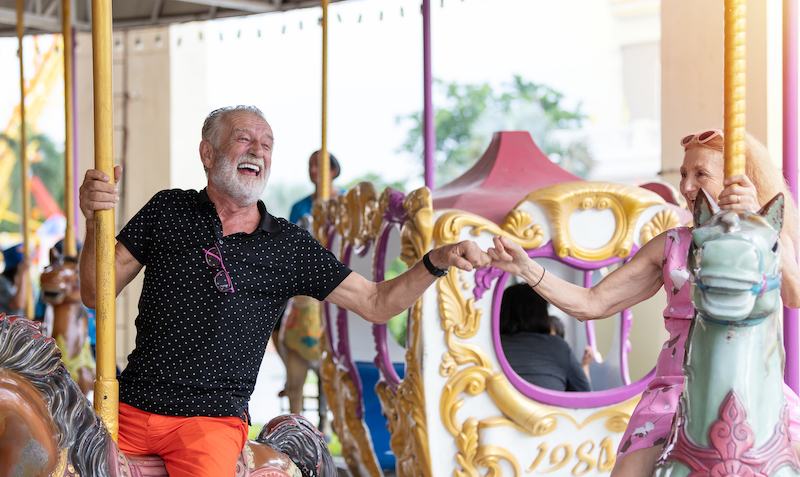
I feel like the words roundabout and merry-go-round get mixed up often, too. So to clarify, when I say merry-go-round, I mean a carousel: the kind with ceffylau (horses) that you see at a ffair (fun fair) or carnifal (carnival). They’re often situated alongside stondinau (stalls) where you can buy cymylau siwgr (candy floss, literally sugar clouds) or compete to win a pysgodyn aur (goldfish).
Dwedodd ei bod hi eisiau mynd ar y chwyrligwgan ac wedyn y roler-coster.
She said she wants to go on the merry-go-round and then the roller-coaster.
Carousels have a particular importance in Welsh culture because they’re often found ar lan y môr (at the seaside). Since so much of Wales is its impressive coastline, seaside resort towns with their pierau (piers) and chwyrligwganod have been an important source of touristic income, and national pride, for a very long time.
A chwyrligwgan (carousel) can also be referred to by the word for its horses in Welsh. So instead of chwyrligwgan – or if that’s not the word used in your dialect – you might hear y ceffylau bach (“the little horses”) or simply y ceffylau (“the horses”). I suspect this is one of those words that has lots of fun regional variations, so do let us know if you have your own version to share!
To talk about riding the merry-go-round, you’d probably just say mynd ar y ceffylau or mynd ar y chwyrligwgan, using the simple phrase mynd ar y (to go on the).
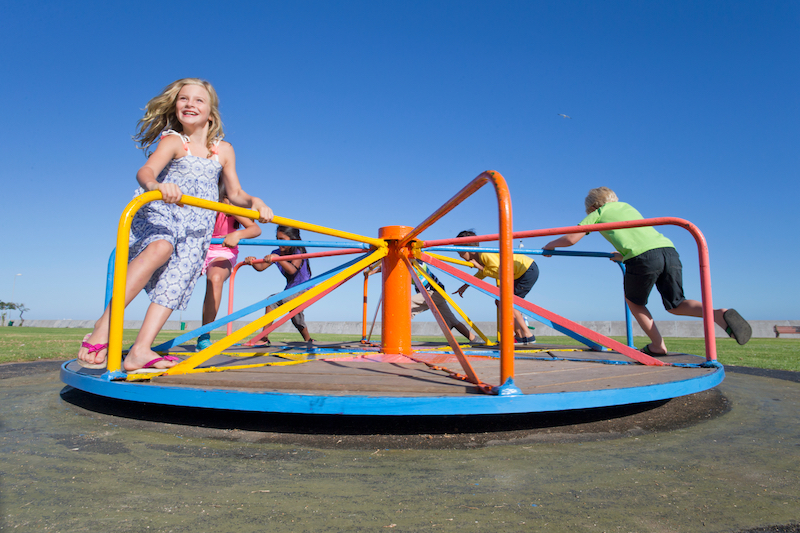
Then what I’m calling a roundabout is more what you’d get at the iard chwarae (playground), alongside siglenni (swings), the sleid (slide), and a ffrâm dringo (climbing frame).
It’s what’s being referred to in the English idiom swings and roundabouts, though in Welsh we eschew the iard chwarae and translate this as ennill ar y menyn, colli ar y caws (winning on the butter, losing on the cheese).
Maen nhw’n mynd i adeiladu iard chwarae newydd efo chwyrligwgan.
They’re going to build a new playground with a roundabout.
Of course this all has nothing to do with the kind of roundabout that ceir (cars) and traffig (traffic) use and are the nemesis of nervous gyrwyr (drivers) everywhere.
Now some dialects call this kind of roundabout a trogylch (turn-circle). But that’s not the most common choice; it’s usually a much less specific word for an orbit, synonymous to cylchdro which you may notice is just the same two words the other way around!
What a roundabout is actually generally called a cylchfan, which literally means circle-place. Never say Welsh words aren’t intuitive!
What is certain is that you’d have to be writing in a very tongue-in-cheek, non-literal way to ever describe a traffic roundabout as a chwyrligwgan. Generally, it’s associated with all things plentynnaidd (childish) and chwareus (playful) – the kind of hwyl (fun, good spirit) we could all do with a bit more of in our day-to-day lives.